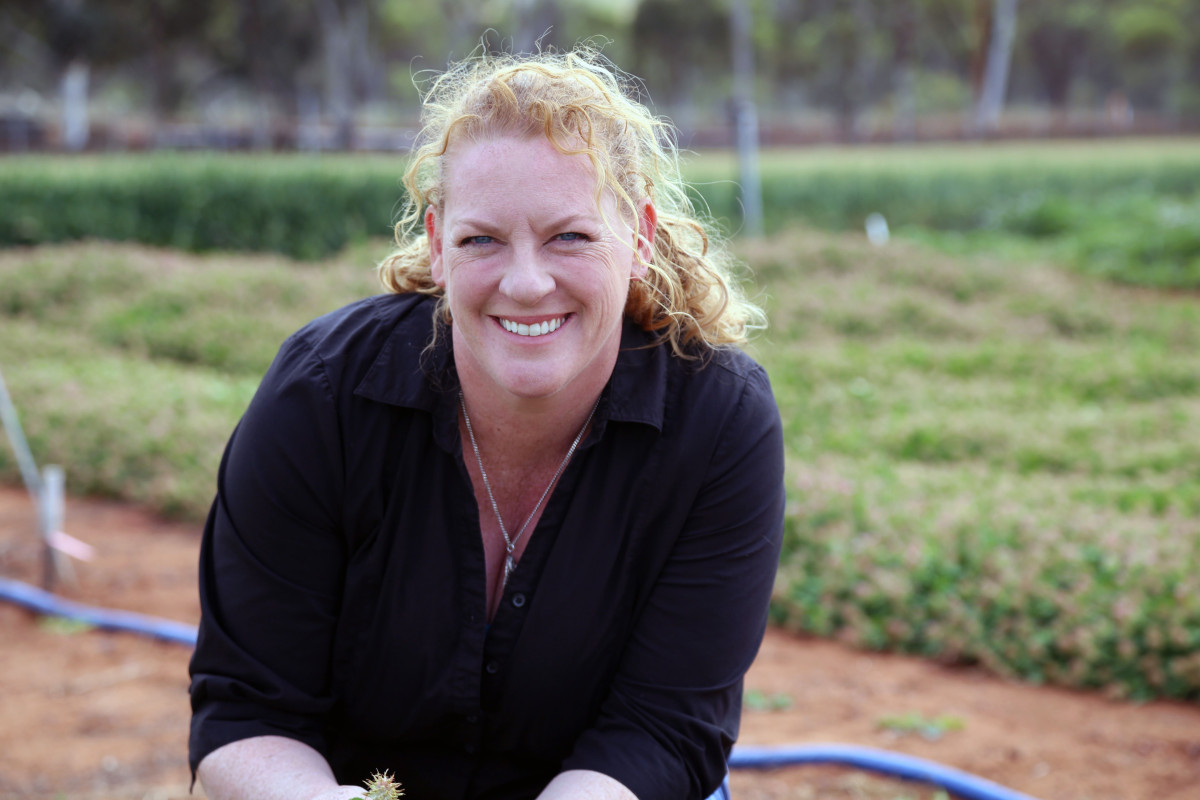

Hayley C Norman
Dr Hayley Norman completed a Bachelor of Agricultural Science and a PhD (Distinction) at the University of Western Australia, working with Prof. Phil Cocks on the reproductive ecology of pasture legumes adapted to dry climates. In 2000 she joined CSIRO, collaborating with Dr David Masters, Dr Robyn Dynes and Dr Ed Barrett-Lennard to develop profitable grazing systems for salinised land within the Salinity and Future Farm CRCs.
Over the past two decades, Hayley has built an internationally recognised research program advancing the role of livestock in Mediterranean and arid farming systems. Her work focuses on optimising the feedbase to meet the year‑round nutritional requirements of ruminants while complementing cropping enterprises. She brings together expertise in animal nutrition, agronomy, plant ecology and near‑infrared spectroscopy (NIRS).
Hayley has led pioneering research to domesticate salt‑tolerant native shrubs, improving their feeding value to enhance profitability, adoption and landscape health. Her team developed innovative methods that incorporate the ‘nutritional wisdom’ of sheep to rapidly identify elite shrub genotypes with higher energy value, an approach that challenges the traditional tendency to consider feeding value late in pasture improvement programs. These capabilities have also been applied to pasture legumes, identifying species with higher feeding value, improved livestock safety and suitability for summer utilisation without compromising seed banks. Her team maintains and refines the faecal NIRS methods developed by Dr David Coates and has produced forage NIRS calibrations for more than 150 pasture and shrub species across the Australian feedbase. This expertise now underpins a Global Methane Hub project, developing calibrations to predict intake, selection, diet quality and methane emissions from sheep and cattle faeces. Hayley also manages the CSIRO ruminant nutrition facility at Floreat, supporting livestock and farming systems research across Townsville, Brisbane, Canberra and Adelaide.
Her scientific contributions are both influential and practical. Key publications include “Halophytes as forages in saline landscapes: Interactions between plant genotype and environment change their feeding value to ruminants” (150 citations), the first evidence that red algae reduces methane emissions from sheep (176 citations) and the AAAS Harry Stobbs Memorial Trust Lecture, “Livestock preference and feeding value as key determinants for forage improvement – why not ask the consumers?” She has published 66 refereed papers and holds an h‑index of 25, alongside extensive industry outreach through television, radio and rural media.
Hayley led the commercialisation of Anameka™ oldman saltbush, an Australian native shrub selected for superior growth, nutritional value and palatability. More than eight million Anameka™ plants have now been established by over 400 producers across Australia. In 2025 she received the W.E. Wood Award for her contribution to salinity and water‑management research.
A committed and enthusiastic collaborator, Hayley works with colleagues from CSIRO, Murdoch University, UWA and DPIRD (WA and NSW) on shade and shelter strategies to improve lamb survival, new feedbase options for meat production in low‑ and medium‑rainfall zones, and the domestication of harvestable annual legumes for mixed farming systems. She has supervised 4 postdoctoral and 20 postgraduate students. Her work has been supported by the Australian meat, wool and grains industries as well as ACIAR, DFAT and DAFF. Hayley has contributed to feedbase research in Afghanistan, Pakistan, Tibet, Iraq and Syria.
Aligned with her research interests, Hayley served as Chair of the WA Soil and Land Conservation Council, is a founding member and Deputy Chair of the WA Livestock Research Council, and contributes to the WA Crawford Fund and the UWA Institute of Agriculture Advisory Board. She is an Associate Editor for Grass and Forage Science and an Adjunct Associate Professor at Murdoch University. A long‑standing supporter of AAAS, she has been a member since 2002, served on the 2006 conference committee and co‑edited the 2020 conference proceedings.
In recognition of her contribution to improve saline landscapes and improving the role of livestock in farming systems, the Australian Association of Animal Sciences is pleased to enrol Dr Hayley Norman as a Fellow.